Chapter 4: ML training/serving Lifecycle - User Restaurant Recommendation example
Example system throughout this chapter: User–Restaurant Recommendation — predict P(order) for each candidate restaurant shown to a user.
Overall Platform Architecture
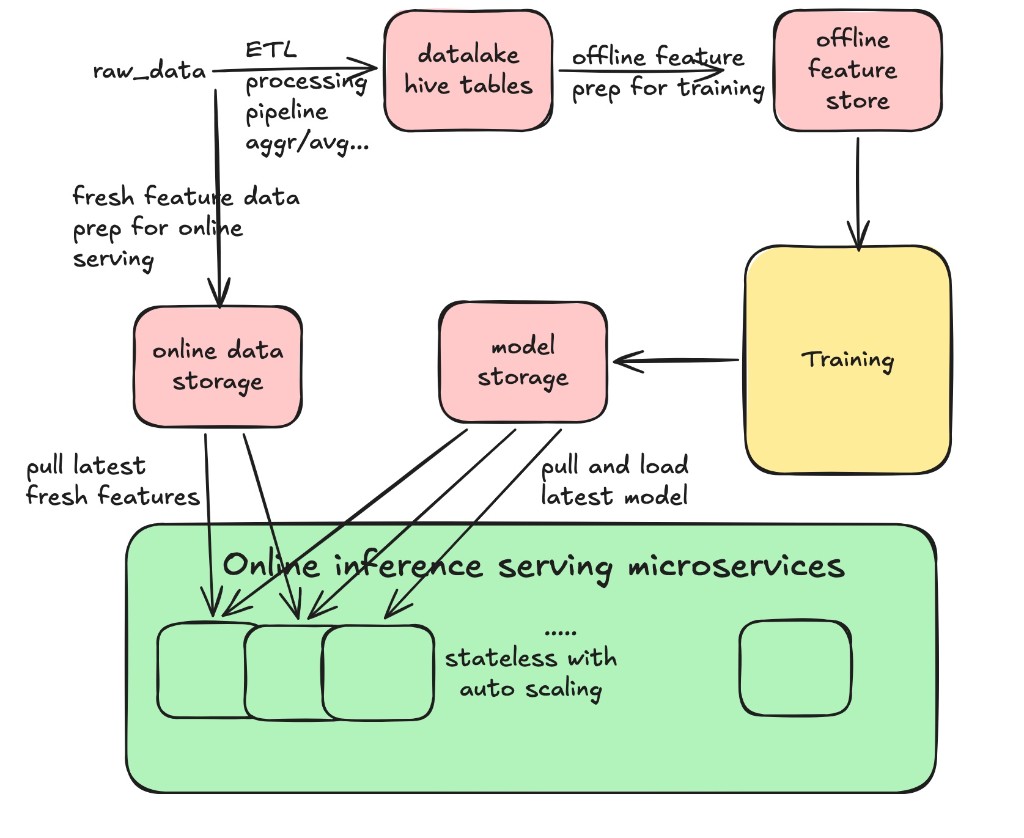
The platform has two distinct pipelines sharing the same feature definitions:
- Offline path — raw data → ETL → data lake (Hive tables) → offline feature store → training
- Online path — online data storage (fresh features) + trained model → inference serving microservices
The inference layer is stateless with auto-scaling — each serving pod pulls the latest features from online storage and the latest model from model storage independently.
The Data: Three Tables, Three Update Cadences
| Table | Key | Contents | Update frequency |
|---|---|---|---|
user_features | user_id | avg order value, food preferences, ... | Weekly |
restaurant_features | rest_id | location, food type tags, ... | Hourly |
events | (user_id, rest_id) | every impression shown, ordered=0/1 | Every impression |
The events table is the spine. It records every (user, restaurant) pair that was actually shown to a user, with ordered=1 if the user placed an order and ordered=0 if not. This is the label.
Training Cycle (Offline)
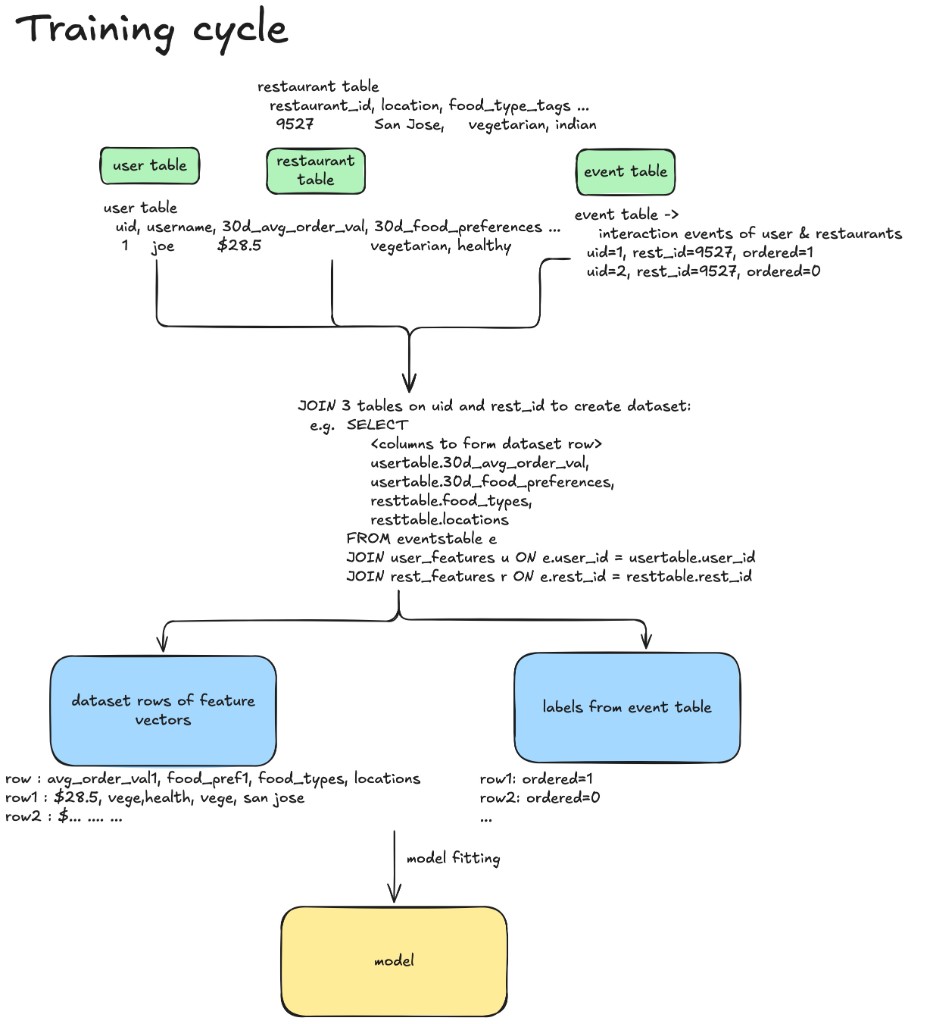
Step 1 — JOIN three tables on shared keys
The events table drives the join. For every event row, pull the matching user features and restaurant features:
SELECT
    usertable.30d_avg_order_val,
    usertable.30d_food_preferences,
    resttable.food_types,
    resttable.location,
    eventstable.ordered          -- label
FROM eventstable e
JOIN user_features u  ON e.user_id  = usertable.user_id
JOIN rest_features r  ON e.rest_id  = resttable.rest_id
Step 2 — Output two artifacts
dataset rows of feature vectors          labels from event table
────────────────────────────             ──────────────────────
row1: $28.5, vege/health, vege, SJ       row1: ordered=1
row2: $...   ...          ...  ...       row2: ordered=0
...                                      ...
The IDs (user_id, rest_id) are dropped after the join — the model trains on pure numeric feature vectors, not on identifiers.
Step 3 — Model fitting
The model learns to map:
[avg_order_val, food_preferences, food_types, location, ...] → P(order)
The trained artifact is stored in a model registry (model storage).
Inferencing Cycle (Online, e.g. target < 50ms)
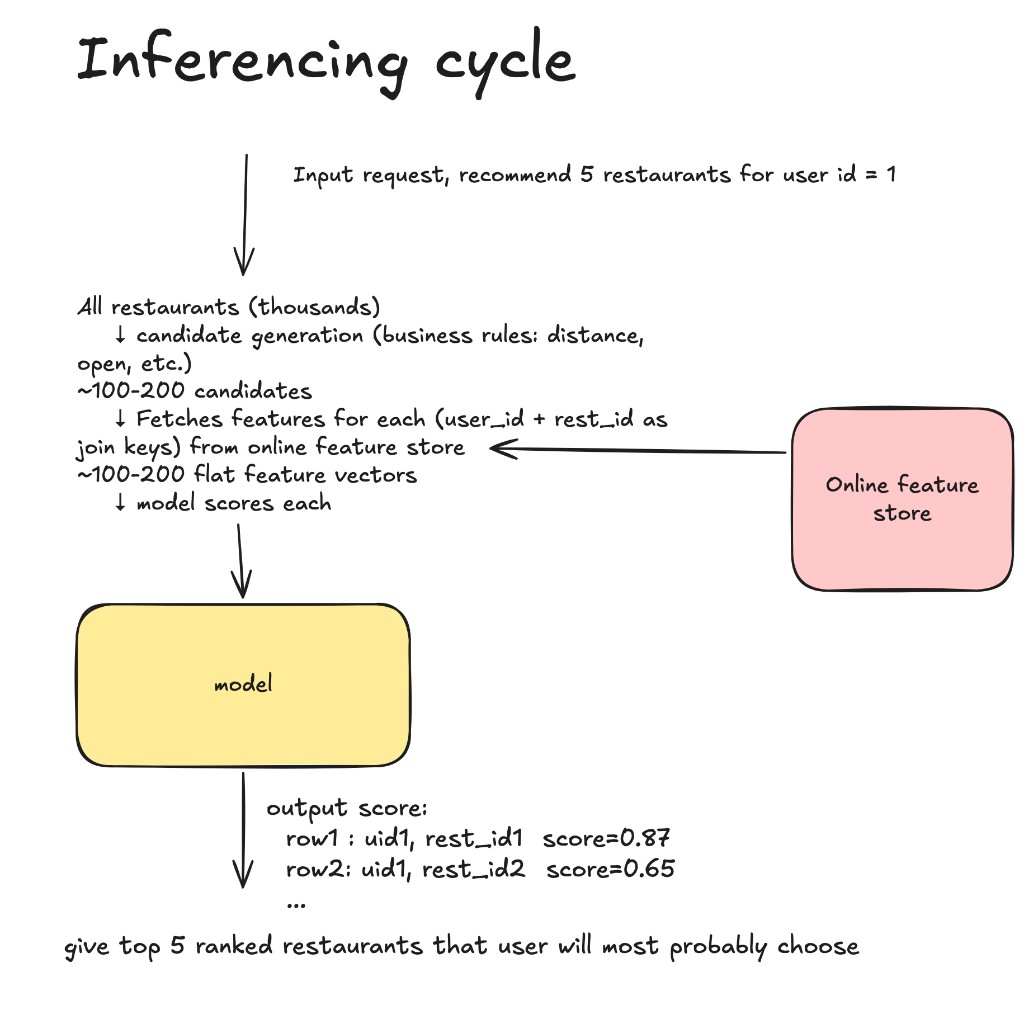
Step 1 — Candidate generation
Input: "recommend 5 restaurants for user_id = 1"
  ↓
All restaurants (thousands)
  ↓  business rules: distance, open now, cuisine filters
~100–200 candidates
This is a coarse filter using cheap rules — no model yet.
Step 2 — Feature fetch from online FeatureStore
For each of the ~100–200 candidates, fetch:
user_features[user_id]— precomputed user featuresrestaurant_features[rest_id]— precomputed restaurant features- Request context computed inline: distance, time of day, etc.
Assemble into the same flat vector shape the model was trained on.
Step 3 — Score and rank
model.inference(feature_vectors)  →  scores per candidate

row1: uid=1, rest_id=9527   score=0.87
row2: uid=1, rest_id=1043   score=0.65
...

return top 5 ranked by score
The serving layer maps scores back to restaurant IDs and returns the ranked list.
Train-Serve Skew — The Silent Failure Mode
The most dangerous bug in ML systems: the model receives inputs at serving time that it was never trained on — and no error is thrown.
What causes it
The model learned patterns from features computed a specific way offline (e.g. 30d_avg_order_val = sum of orders over last 30 days). If the online path computes that same feature differently — different time window, different null handling, different units — the model silently receives wrong inputs.
Offline (training):
  30d_avg_order_val = SUM(orders) / 30  using Hive UDF version 1.2

Online (serving):
  30d_avg_order_val = SUM(orders) / 30  using Java service — but nulls handled differently!
                                         model sees 0.0 where it expected NULL → wrong prediction
No exception is thrown. Predictions degrade silently.
How FeatureStore prevents it
FeatureStore is the single source of truth for feature definitions, shared between both paths:
                    FeatureStore
                  (feature definitions)
                   /               \
        Offline path             Online path
       (Hive / Spark)         (serving microservice)
    same definition →         same definition →
    same computation          same computation
         ↓                          ↓
    training data              serving input
         └──────── model trained and served on ────┘
                   identical feature distributions
If the offline and online feature computation ever diverge, FeatureStore catches it at definition time — not at prediction time.
Chronon — making skew measurable instead of silent
Chronon originated at Airbnb (previously called Zipline) and is now open source. It's a feature platform — it handles both feature computation and retrieval, not just storage.
The key difference from a simple feature store (e.g. Redis): Chronon is designed to structurally solve train-serve skew, not just prevent it by convention.
The core mechanism: feature logging + backfill consistency check
You define features in one place. Those definitions are used for both training data backfills and online serving. Then Chronon enforces consistency through a measurement loop:
Online serving
  ↓
FeatureStore returns feature values to the model
  ↓
Chronon logs: {primary keys, timestamp, feature values returned}
  ↓  (offline, asynchronously)
Backfill job: given the same keys + timestamps, recompute features via Hive/batch path
  ↓
Diff: logged online values  vs  backfilled offline values
  ↓
Any divergence = measurable skew  ← no longer silent!
In plain terms: every time FeatureStore serves a feature at inference time, Chronon records what was returned. Later, it recomputes those exact same features using the offline batch path and diffs the two. Any mismatch is now a metric, not a silent bug.
| Approach | Skew handling |
|---|---|
| Simple FeatureStore (Redis) | Single definition shared by convention — divergence is possible and silent |
| Chronon | Logs every online fetch, backfills offline, diffs continuously — skew is measured and alertable |
Key Terms
| Term | Plain English |
|---|---|
| Feature vector | A flat numeric array representing one training example — all IDs dropped, all values numeric |
| Spine table | The table that drives the JOIN — in this case events, one row per training example |
| Train-serve skew | When offline (training) and online (serving) compute the same feature differently — silent degradation |
| Candidate generation / coarse ranking | Coarse filtering step before the model runs — reduces thousands of options to ~100–200 using cheap business rules |
| Model registry | Storage for trained model artifacts — versioned, with metadata |
| Online feature store | Low-latency key-value store for precomputed features, keyed by entity ID (user_id, rest_id) |
| Offline feature store | Batch-oriented store for historical features used during training (Hive, Parquet, etc.) |